
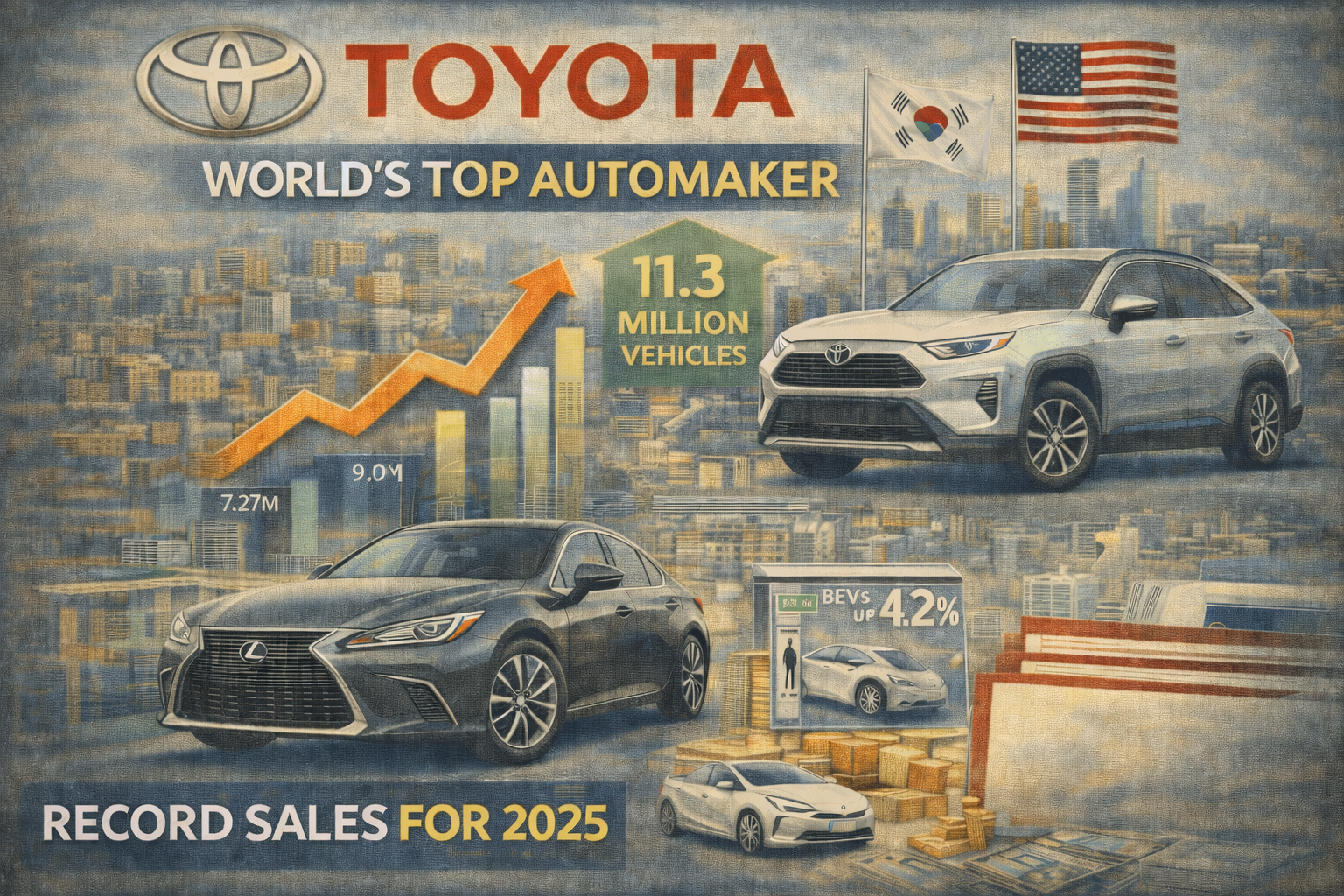
Toyota Motor retained its position as the world’s top-selling automaker in 2025, reporting record vehicle sales despite ongoing disruption from US tariffs and intensifying global competition.
The Japanese carmaker said on Thursday that sales of Toyota and its Lexus luxury brand rose 3.7% from a year earlier to 10.5 million vehicles.
That comfortably exceeded deliveries from rivals Volkswagen Group, which sold about 9 million units, and Hyundai Motor Group, which reported sales of 7.27 million vehicles.
Including subsidiaries Daihatsu Motor and Hino Motors, Toyota’s group-wide sales climbed 4.6% to a record 11.3 million vehicles in 2025, cementing its global lead.
Hybrids drive US strength despite tariffs
Toyota’s performance was underpinned by strong demand for hybrid vehicles, particularly in the US, where models such as the Prius and RAV4 remained popular.
Sales of Toyota and Lexus vehicles in the US rose 7.3% to 2.93 million units.
The gains came despite an aggressive tariff regime rolled out by US President Donald Trump, who initially imposed 25% levies on Japanese automobiles before reducing them to 15%.
Toyota opted to absorb much of the tariff-related cost rather than pass it on to consumers through broad price increases, while leaning on local production and other cost controls.
The company estimated in November that US tariffs would still cost it 1.45 trillion yen ($9.7 billion) in its fiscal year ending March 2026.
Even so, it raised its full-year operating profit forecast, citing successful cost reductions and resilient demand outside the US.
Toyota said exports from Japan to the US increased 14% to about 615,000 vehicles in 2025, while reliance on imports remained relatively low, with only around one-fifth of its US sales sourced from abroad.
Rivals feel sharper tariff impact
Tariffs have weighed more heavily on some competitors.
Hyundai Motor reported global revenue growth of more than 6% in 2025, supported by strong hybrid sales in the US, but its operating profit fell 19.5% from the previous year.
The South Korean automaker said US tariffs cost it about 4.1 trillion won.
Although South Korea and the US agreed last year to lower tariffs on most South Korean products, including cars, to 15% from November, Trump this week threatened to raise duties back to 25%, saying the country’s legislature had not moved fast enough to implement the deal.
Hyundai shares fell nearly 5% following the comments.
Hyundai’s exposure reflects its heavier reliance on imports, with only about 40% of its US sales produced domestically in 2025.
The company aims to raise that figure to more than 80% by 2030 through expanded manufacturing at its Georgia facilities.
EV transition and outlook
Toyota continues to benefit from its long-standing focus on hybrid technology, even as it trails rivals such as BYD and Tesla in battery electric vehicles.
Toyota said sales of battery electric vehicles rose 42% last year to about 199,000 units.
By comparison, BYD sold 4.6 million vehicles in 2025, including roughly 2.26 million battery electric vehicles, while Tesla delivered about 1.64 million vehicles.
Toyota said it is investing more than $900 million to boost hybrid production in the US, part of a broader plan to invest up to $10 billion in the country over the next five years.
Group global production rose 5.7% to 11.2 million vehicles in 2025.
The company is scheduled to report its fiscal third-quarter earnings on Feb. 6.
Analysts expect operating profit to rebound nearly 30% from a year earlier, according to Reuters estimates.
Toyota shares rose 3% in trading on Thursday.
The post Toyota tops global auto sales in 2025 as hybrids offset US tariff pressure appeared first on Invezz